
Anchor Stores in Modern Shopping Malls in Iran | Atlas Toos Group
Anchor Stores: Economic Role, Market Analysis, and Mall Management in Modern Iranian Shopping Centers MAHDI KOUPAEI Table of Contents Introduction Definition of Anchor Stores Economic Role Advantages & Disadvantages Impact on E-Commerce Market Analysis in Iran Successful Iranian Examples Strategies & Leasing Models Operational Challenges & AI Integration Conclusion & Atlas Toos Group Services Introduction Modern shopping malls are not just spaces for purchasing goods—they serve as platforms for customer experience and brand development. One of the key concepts in mall design is anchor stores. The term “anchor” literally means a stabilizing force; in retail, it refers to stores that attract significant foot traffic, acting as anchors for other mall tenants. This article explores the concept, economic role, and market analysis of anchor stores in modern Iranian shopping centers. Definition of Anchor Stores Imagine standing in a large shopping mall, looking at the floor map. Stores occupying the largest spaces, with prominent signage and strong brand recognition, are typically considered anchor stores. They attract people, maintain steady foot traffic, and indirectly benefit other retailers in the mall. In Iran, notable examples include: Iran Mall, Palladium Tehran, and Isfahan City Center. These anchor stores not only attract customers but also increase footfall and sales across smaller units. Economic Role of Anchor Stores Anchor stores play a crucial role in the economics of shopping malls. Their primary contribution is increasing customer traffic, which benefits other tenants through higher demand and rental income. Additionally, the presence of well-known brands enhances the mall’s branding and strengthens its competitive position in the market. Advantages & Disadvantages Advantages Increased foot traffic and steady visitor flow Higher overall sales and revenue for the mall Enhanced shopping experience and brand perception Opportunities for smaller and new retailers Disadvantages High rent and initial investment for anchor stores Over-dependence of the mall on a few key brands Risk of decreased visits if an anchor closes or rebrands Impact on E-Commerce and O2O Strategy In the digital era, anchor stores maintain both physical and online presence. Integrating e-commerce with in-store experience (O2O strategy) allows customers to order online and pick up in-store, or complement in-store visits with online purchases. This approach strengthens customer loyalty and expands market reach. Market Analysis in Iran The Iranian shopping mall market has grown significantly in the past decade, with over 300 medium and large centers nationwide. Iran Mall, with over 110,000 square meters, is…
Anchor Stores: Economic Role, Market Analysis, and Mall Management in Modern Iranian Shopping Centers
Introduction
Modern shopping malls are not just spaces for purchasing goods—they serve as platforms for customer experience and brand development. One of the key concepts in mall design is anchor stores. The term “anchor” literally means a stabilizing force; in retail, it refers to stores that attract significant foot traffic, acting as anchors for other mall tenants. This article explores the concept, economic role, and market analysis of anchor stores in modern Iranian shopping centers.
Definition of Anchor Stores
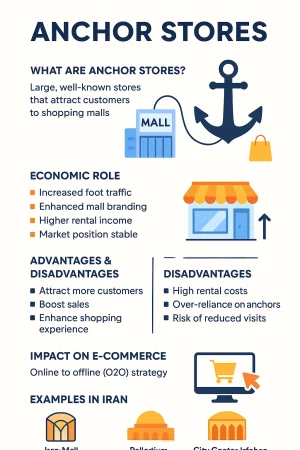
Imagine standing in a large shopping mall, looking at the floor map. Stores occupying the largest spaces, with prominent signage and strong brand recognition, are typically considered anchor stores. They attract people, maintain steady foot traffic, and indirectly benefit other retailers in the mall.
In Iran, notable examples include: Iran Mall, Palladium Tehran, and Isfahan City Center. These anchor stores not only attract customers but also increase footfall and sales across smaller units.
Economic Role of Anchor Stores
Anchor stores play a crucial role in the economics of shopping malls. Their primary contribution is increasing customer traffic, which benefits other tenants through higher demand and rental income. Additionally, the presence of well-known brands enhances the mall’s branding and strengthens its competitive position in the market.
Advantages & Disadvantages
Advantages
- Increased foot traffic and steady visitor flow
- Higher overall sales and revenue for the mall
- Enhanced shopping experience and brand perception
- Opportunities for smaller and new retailers
Disadvantages
- High rent and initial investment for anchor stores
- Over-dependence of the mall on a few key brands
- Risk of decreased visits if an anchor closes or rebrands
Impact on E-Commerce and O2O Strategy
In the digital era, anchor stores maintain both physical and online presence. Integrating e-commerce with in-store experience (O2O strategy) allows customers to order online and pick up in-store, or complement in-store visits with online purchases. This approach strengthens customer loyalty and expands market reach.
Market Analysis in Iran
The Iranian shopping mall market has grown significantly in the past decade, with over 300 medium and large centers nationwide. Iran Mall, with over 110,000 square meters, is among the largest malls in the Middle East. Modern malls like Palladium, Artemis, and Isfahan City Center generate substantial revenue through anchor tenants and international brands.
Analysis shows malls with reputable anchor stores can experience up to 40% more visitors and 30% higher sales than those without, highlighting the strategic importance of anchor tenants in Iran.
Successful Iranian Examples
Iran Mall: Hyperstar and international luxury brands. Palladium Tehran: Focus on luxury apparel, electronics, and home appliances. Isfahan City Center: Mix of domestic and international brands with leisure facilities. These cases illustrate that proper anchor selection ensures overall mall success.
Strategies & Leasing Models
Choosing anchor stores requires data-driven analysis: target demographics, traffic patterns, local economic power, and mall identity are key factors. Long-term contracts with performance clauses, variable rent based on sales, and incentive packages can distribute risk and encourage collaboration with anchor brands.
Operational Challenges & AI Integration
Operational coordination with anchors (parking, logistics, after-sales services) is complex. Smart systems for traffic monitoring, parking reservations, and inventory management reduce operational burden. Data analytics and AI can predict demand, optimize promotions, and guide real-time decisions, offering a competitive edge.
Anchor stores can implement services like click-and-collect, product showcase kiosks, and experience-based events to enhance customer engagement and in-store visits.
Conclusion & Atlas Toos Group Services
Anchor stores remain a cornerstone of mall design and economics. They drive customer traffic, boost other retailers’ sales, and enhance mall credibility. As modern Iranian malls evolve and consumer behavior embraces blended online-offline experiences, strategic anchor selection and management deliver significant returns for mall owners and investors.
Atlas Toos Group Specialized Services
- Customer Flow Analysis & Optimization: Designing traffic patterns using data insights.
- Anchor Store Management: Selection, leasing, and monitoring key tenants.
- Operations & Maintenance Management: Streamlining services, security, cleaning, and maintenance.
- Marketing & Branding Strategy: Joint campaigns, promotions, and events with anchor stores.
- Technology & Smart Solutions: Sensors and analytics software for real-time operational decisions.
For more information and expert consultation on anchor store selection and mall operations, contact Atlas Toos Group. Our team designs operational plans, leasing models, and smart solutions tailored to your project, ensuring maximum ROI and sustainable growth. Get started today with a complimentary initial consultation.